Showing posts with label butterflies. Show all posts

Monday, 14 July 2014

Large Skipper

Last year we were fortunate to see a Dingy Skipper butterfly in the garden. On Saturday we had the much more common variety, a Large Skipper, visit the garden. It seemed to really enjoy sunning itself on some bricks we've been using to mark out sections of the garden as we continue to work on adding borders.

I thought we had seen one in the garden before, but there is nothing written in my butterfly book, so it might be a new species for the garden. Either way it was a nice diversion from working in the garden!

Sunday, 9 June 2013

Skipper, The Garden Isn't Really That Dingy!

Given that we seem to have been having something approaching summer for the last three weekends we've spent quite a bit of time working on the garden. In fact, depending which direction you look, it's starting to look really good. There is still an awful lot of work to do so fingers crossed summer will continue for a few more weeks.

Anyway, while we were sat out in the garden enjoying lunch yesterday we spotted a new species of butterfly for the garden. At first we thought it might be a moth from the way it was flying, but it turned out to be a Dingy Skkipper (or if you prefer the Latin Erynnis tages). Not only is this a new species for the garden, I don't think I've ever seen one before anywhere else. In fact I'm quite surprised to see one in the garden, as my guide suggests it prefers south-facing downland slopes, something our garden definitely isn't.

Friday, 7 September 2012

A Single Scotch

As well as drinking a far amount of single malt Scotch Whiskey while on Skye (Laphroaig Quater Cask if you're interested) we also saw another form of Scotch; a single specimen of a Scotch Argus (Erebia aethiops) butterfly.

This is only the second time I've ever seen a Scotch Argus even though I've had a number of holidays throughout Scotland over the years. I almost didn't recognize it as this specimen is very brown compared to the ones I've seen before which were almost black. This one was sunning itself just outside Portree, while I've previously seen them under Glenfinnan Viaduct.

Friday, 13 April 2012

I Collected Dead Things

In August last year I blogged about some pictures I'd seen in a hotel room that were made from moth and butterfly wings. In the comments to that post I mentioned that as a child I used to collect moths and butterflies and that they were pinned and labelled in old soap boxes in my parents house. I also promised that at some point I'd do a post about the collection.

Now I can't remember when I first started the collection, although I do know the lid decoration came quite a bit later when I used the collection to gain my Collectors badge in the Cub Scouts.


Now the lid should help explain the title of this post; I only ever collected specimens which I found dead. I would never have (and still wouldn't) consider killing a moth or a butterfly to add it to a collection. Not that I've add to the collection in a number of years, mostly as the boxes have been in my parents loft as Bryony won't let me have them in the house (she likes butterflies but hates moths, even if they are dead), but also as it's a long time since I've actually seen a dead moth or butterfly.

Now I know there are plenty more people, like Bryony, that don't like moths and/or butterflies so for the first time on this blog I'm going to make you click through to the rest of this post so you only see the photos if you want to (although if you are reading this on the post page then the link will be missing and that whole sentence won't make much sense, but nevermind).

Sunday, 11 March 2012

Confused By The Weather

Along with most of the UK we have been having a rather mild couple of weeks. So mild in fact that I've already seen a butterfly!

I'm not sure where it had been over wintering but on the 24th of February my attention was distracted by a Speckled Wood sunning itself on the inside of my study window. It was a warm enough day to have the window open but I wouldn't have thought it was late enough in the year for butterflies. Unfortunately I have a number of plants on my windowsill which got in the way of a decent photo (every time I tried to move one of them it upset the butterfly so it didn't seem worth trying too hard). After about twenty minutes it eventually flew out of the open window.

I've no idea if it will have survived the cooler temperatures overnight, but there is definitely something weird going on with the seasons this year. There was blossom on a cherry tree nearby just after Christmas and now a butterfly in February!

Saturday, 13 August 2011

Infinite Butterflies

If an infinite number of monkeys bashing randomly on a typewriter will eventually produce the collected works of Shakespeare and one butterfly flapping it's wings can generate a thunderstorm, I wonder if an infinite number of butterflies randomly flapping their wings would eventually produce the art hung on the wall in my hotel room a few weeks ago?

There were three African looking pictures on the wall of my room; a pair of parrots, a woman carrying a bowl on her head, and a pair of woman (shown to the left). It was at least 24 hours after I'd checked in before I noticed that there was something odd about the pictures. A close inspection seemed to suggest that each picture was actually made up of lots of butterfly wings!

Given that the pictures were framed and behind glass it was hard to be certain but the wings did look natural and had stained the mounting paper as I would have expected them to. After a bit of googling I'm fairly certain that they are made from real butterfly wings and are the work of Paul Caparatta who runs Butterfly Utopia. As well as pictures made from the butterfly wings, he also sells mounted butterflies and jewelery made from butterfly wings.

Thursday, 30 June 2011

Hortus Lepidopterans

Okay so the Latin title might not be linguistically correct, but it has a better feel to it than "Garden Moths and Butterflies" which is what this post is all about.

Ever since we bought our house we have been slowly working on transforming the square lawn, which takes up all the flat area of the rear garden, into something more interesting with flowers and shrubs etc. Last year we used a whole bunch of bricks to mark out where we wanted the borders and a pond to be. Unfortunately we haven't had the time to actually do all the work yet.

The back left corner of the garden will eventually hold the pond and a bit of a bog garden as well as a small patio and a bench. Currently though, we have simply let this corner go wild to produce an interesting habitat for good old fashioned British wildlife. This means lots of tall grass, ragwort, dock and a whole bunch of other plants. One side effect of this is that the number of species of moths and butterflies we are seeing in the garden is increasing.

So far this year I've managed to identify and photograph two new species of moth and a butterfly.


From left to right we have:
Tyria jacobaeae
A day flying moth more commonly referred to as a Cinnabar. This is likely to have been attracted to the garden by the ragwort growing wild in what will eventually be a pond as this is the favourite food of it's larval form.
Polyommatus icarus
Last year we actually saw quite a few blue butterflies flitting around the garden. Unfortunately they either flew over the fence or were eaten by the Robins before we had a chance to identify them. This year, however, I finally found one sunning itself in the border and it sat still long enough for me to identify it as a Common Blue. It's a shame I didn't manage a photo of the bright blue upper wing surfaces but all the identifying characteristics are actually in the photo.
Diachrysia chrysitis f. aurea
I found this Burnished Brass moth in the herb border today while I was mowing the lawn. It was sitting in the marjoram which isn't really surprising given that my moth book lists marjoram as one of the larval food plants.
So I'm sorry if any of my neighbors think that the garden looks a little untidy, it will improve slowly, but until we have the time I'd prefer it to be a haven for British wildlife then a boring lawn.

Sunday, 11 July 2010

Wessington Pasture

After wandering around Broadmoor Common we all jumped back in the cars and made a second attempt at finding Wessington Pasture. This time we were successful. The reserve is a mixture of woodland and open pasture and we saw quite a lot of wildlife.

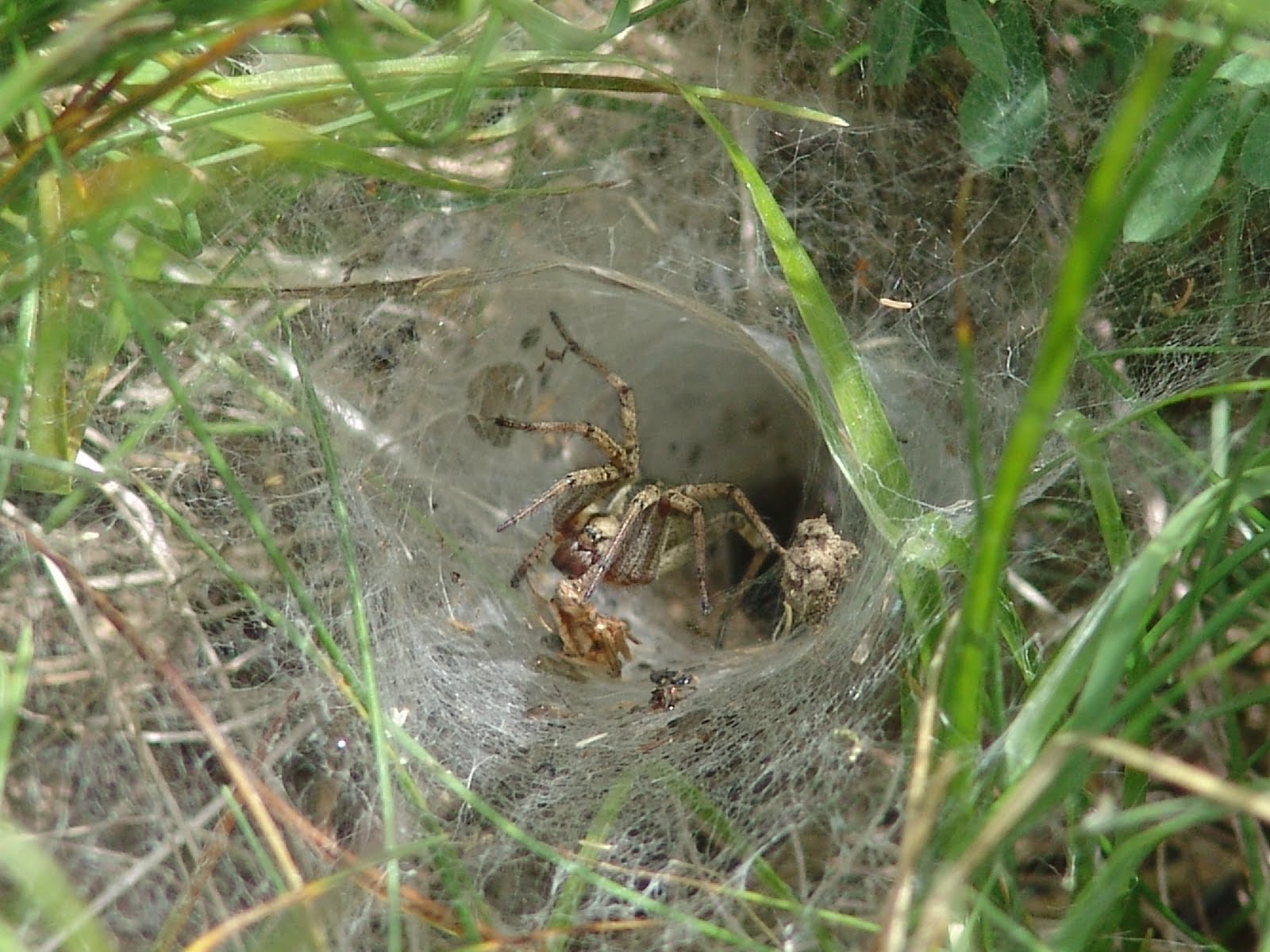
Marbled WhitesAn Aggressive SpiderCommon Green Grasshopper

We didn't see much in the wooded section (apart from a quick flash of a green woodpecker) but again we saw lots of Marbled Whites in the pasture. In fact one of the first things we spotted was a pair of mating Marbled whites. The nicest thing about seeing this pair is that we can tell the difference between the sexes -- the female has slightly orange tinted underwing.

When I got bored photographing the Marbled Whites I moved on to a rather aggressive spider that Bryony had found. No idea what species of spider it is but if you got anywhere near it's funnel like web it would shoot straight out at you. On one occasion it nearly jumped onto the camera lens. Having previously been bitten by a spider (slight tinkling and a little swelling) I decided to escape before it could do me any damage.

The last new thing I photographed at the pasture was a charming little Common Green Grasshopper (or at least that is what I think it is from looking at Bryony's field guide). He was very patient and just sat there for ages while I took a number of photos some, like this one, using the camera's macro function about 2cm from him! On the way back to the car I spotted only my second Harlequin Ladybird to add to the day's species list.

Note that if you visit the pasture please don't park on the road. If you open the gate you can drive down to a small car park. We left the cars on the road as it wasn't obvious there was a car park and came back to find a pleasant note from the farmer asking us not to park on the road in the future.

Wednesday, 7 July 2010

Broadmoor Common

Over the weekend, whilst staying at The Bowens in Fownhope, we did a number of short walks and took an awful lot of photos (616 to be precise -- or, in old money, just over 17 rolls of 36 exposure 35mm film). I thought that rather than writing one long post I'd do a number of shorter posts one for each of the places we visited.

On the Saturday morning we set out in the cars to visit Wessington Pasture. Unfortunately we missed the turning (it looked like the entrance to a farm) and ended up at Broadmoor Common instead. According to the information board the common represents a fine example of a flower-rich ancient grassland. The abundance of wild flowers makes it an ideal habitat for moths and butterflies and they didn't disappoint.

RingletSix Spot BurnetMarbled White

As we stepped out of the car I got flown at by a Ringlet butterfly which was considerate enough to then land on some brambles right next to the car and in an ideal place for a photograph. Of course I don't really need to go all the way to Herefordshire to see Ringlets; we had some in the garden yesterday, well we did until the Robin ate one! Just as I was finishing photographing the Ringlet there was a cry from the other side of the car park as my mother had spotted something much more interesting, a Marbled White.

I've never seen a Marbled White before and neither had Bryony. I guess I shouldn't have been overly surprised by their presence. There was a photo of one on the information board and my butterfly book states that the unmistakable Marbled White is a lovely butterfly of unimproved flowery grassland, which seems to match the description of the common on the board. Unfortunately they don't seem to like sitting still, rather they flit from flower to flower annoyingly fast for someone who is trying to take their photograph. In fact it wasn't until we were nearly ready to leave that I finally got a decent photo.

There were other butterflies flitting around (definitely a Small Tortoiseshell) but I didn't get any photographs. I did, however, manage to photograph a day flying moth, specifically a six spot Burnet moth. This sat quite still on a thistle for quite a while allowing us all to take as many photos as we wanted. It still hadn't really moved when we decided to walk a little further up the road.