In the
previous parts of this tale I've introduced my first train set and given a very brief history of the Flying Scotsman up to September 1983 when it was housed and maintained at Steamtown in Carnforth, where this exciting episode of Cautionary Tale No. 4472 continues the story.
I'd just had my fourth birthday and we had gone on holiday, renting a self catering house in Arnside just north of Carnforth in Cumbria. There was me, my younger brother (who spent much off the time crying while cutting teeth), my parents and my Grandma. I'm not sure how long the holiday was, probably a week, or how long we had been there but on the 18th of September 1983 we all visited Steamtown in nearby Carnforth.
Steamtown was original a British Rail engine shed, but had by this time become one of the primary steam engine preservation sheds. Many, if not most, of the steam engines certified to run on the mainline network were stored and maintained at Steamtown and as such it was a great place to visit. While this is still it's primary function, under it's current owners
West Coast Railways, it is unfortunately no longer open to the public (for more details see this brief
history page). Back in 1983 though it was a fantastic place to visit, especially for a 4 year old with a fascination for steam engines.

For me the highlight of the day was going to be seeing Flying Scotsman for the first time. It was amazing, and huge. Steam trains still seem large but to a four year old it really was unbelievably big. Unfortunately, it wasn't steaming on the day we visited but it was on display in one of the sheds. Of course given the limited room in the sheds this meant getting photos of it was difficult, but my Dad did his best, and at least managed a photo of the name plate.
We spent quite a bit of time wondering around Steamtown having a wonderful day. At the time there was quite a lot to see both in the sheds and out by the water tower and turntable. To get a feel for what it was like I'd recommend visiting this
gallery of photos which covers the period I visited in. It really was a glorious day and all too soon it came time to leave. Of course I didn't want to leave without just one more look at the Flying Scotsman, so we headed back towards the sheds for one final look.
Now I don't know how many of you will have ever wondered around an engine yard but as you can guess there are train tracks everywhere. We were following one set of tracks back to the sheds and I was holding onto my Grandma's hand. I don't know why but I decided it would be fun to jump from one railway sleeper to the next rather than simply walking. Now this was relatively safe at the sedate pace of my Grandma, but disaster was bound to strike as soon as I decided to go a little faster and let go of her hand.
I don't know how far apart railway sleepers are spaced but for a four year old they are probably too far apart to be jumping from one to the next at speed -- or maybe I just had short legs. Anyway I hadn't got far before I missed placed my footing and fell. Now falling in a railway yard would always have ended with a cut, even if only a nasty knee graze, but with my unsurpassed aiming skills I managed to land head first on one of the bolts that holds the metal track to the wood sleeper.
Quite surprisingly, I don't remember it being painful. I do, however, remember there being a
lot of blood. People always say that head wounds bleed heavily and as an expert in the field (since this incident I've used at least a coffee table, metal window frame and a car boot lock to draw blood from my head) I can confirm that they do. I assume my parents were in a bit of a panic by this point but for some reason my memory of the events following me falling are a little on the fuzzy side! The next thing I remember clearly is reading a book.

My parents had managed to get me back towards the entrance and attract the attention of a member of staff. For some reason rather than phoning for an ambulance I was driven to the nearby hospital. I think we went in the car of a member of staff who knew the way to the hospital. My mum, brother and grandmother certainly went straight back to where we were staying while my Dad went with me to hospital. To keep me occupied in the car I was given the
Ladybird Leaders book of trains from the shop. I don't know how much of it I read or looked at in the car as I was worried about dripping blood onto it. As you can see from the picture even 24 years later it is still in relatively good condition. Ignoring christening presents and the train set this is probably the earliest gift that I still have and cherish in a weird way.
And now for a useful tip for anyone who ever finds themselves having a child who falls over cutting his head on a railway bolt and needs stitches in the middle of his forehead. The child will find the stitching equipment quite scary especially when it is so close to his eyes and so can see exactly what is going to happen next. Trying to find enough hospital staff to fully restrain a screaming four year old is a big challenge. What you need to find is a small towel (
you should always know where your towel is at). Simply place the towel across the child's eyes so they can't see what is going on and they will lie perfectly still while their forehead is stitched up. Thanks to the matron at the hospital for that very useful parenting tip!

Fortunately I wasn't left with any permanent damage other than a lovely X shaped scare in the middle of my forehead. It is no longer very visible unless I tan, but as you can see from this school photo it used to be a lot more visible.
So the main point of Cautionary Tale No.4472 is that if at four years old you find yourself wondering around a railway yard try not to run along the sleepers. I speak from a position of experience when I tell you it won't end well!
And in the next, and final, exciting instalment I'll bring you up to date on my experiences of seeing Flying Scotsman, with the additional promise that there will be no further mention of blood!


 If you've been following Cautionary Tale No. 4472 through parts I to IV (which you can read here, here, here, and here) then you might want to head on over to my new blog to read (the probably final) Part V of this fascinating tale.



 Thursday, 5 July 2012
 I consider myself to be fairly well read and as such have a fairly large vocabulary. It is unusual, therefore, for me to come across not only a word I haven't heard before but one for which I can't even work out a meaning from it's context. The word in question... quinquennium.
 When we moved in the main accessible area of the garden was just one large square of grass without any borders or interesting features other than a rusty old metal swing. We have quite a few plans for the garden but none of them involve a swing! So one of the first jobs this year was to remove the swing. I'd actually put it off a few times as I thought it was going to be quite a lot of work but on Saturday afternoon I was encouraged into having a go. Removing it was actually a lot easier than I expected.
 Berlin contains what has to be the biggest memorial I have ever seen. The Holocaust Memorial covers 19,000 square metres of prime Berlin real-estate and consists of 2711 differently sized concrete blocks and apparently doesn't actually represent anything in particular. I'm guessing if the memorial has any meaning it is that the huge scale of the memorial reflects the scale of the atrocities it remembers. At night wondering among the blocks is quite eerie but it was a good place to stand for a few minutes quietly contemplating history.
 Last night a small group of us went on a walk around the centre of Berlin to see some of the more famous sites. It was a really clever idea as one of the complaints with work meetings is that we never really get the chance to see the places we visit as we are working all day long. We started at Potsdamer Platz which is an important public square and traffic intersection.

 All six tapestries are housed at the Musée de Cluny, officially known as Musée National du Moyen Âge (National Museum of the Middle Ages in English), in Paris. We weren't allowed to take photos when we visited but someone obviously did as they posted the accompanying photo on Wikipedia. The museum website has a section devoted to describing the tapestries which is worth a read. Having been to the museum and seen the tapestries I can easily state that it is worth a visit if you are ever in Paris. The museum also houses a number of fantastic medieval illustrated manuscripts which I could easily look at for hours on end.


 I always thought that the phrase HC SVNT DRACONES (or Here Be Dragons for those of us who don't speak Latin) had traditionally been used on maps to denote the edge of the known world. It turns out that this isn't true. The only historical map to use the phrase is the Lenox Globe which dates to around 1510 and has the phrase inscribed near the eastern coast of Asia.


 In a previous post I showed you a 1797 George III copper "cartwheel" penny. Unfortunately the specimen I have is so badly worn that seeing any detail on the real thing is almost impossible but on the photo I'd be surprised if you could even tell it was a coin!
 I alluded last time to the remarkable detail of the coins when seen on a good specimen. The intricate detail made it almost impossible for forgers to copy the coins. To show you what I mean have a look at the detail on the ship seen to the left of Britannia on the coin. Given that this coin is now 211 years old the fact that on such a small part of the coin you can clearly see the sails, rigging and gun ports is amazing.
 As I mentioned in a previous post our coins are changing. At the moment only the reverse designs are being altered and not the size, weight or composition of the coins. Over the last decade or so we have, however, seen the 5p, 10p and 50p coins reduced in size. To put our current coins in perspective though I thought I'd show you the oldest coin I own -- a 1797 George III "cartwheel" copper penny.
 I had my first computer, a Dragon (I've no idea if it was the 32 or 64 kilobyte version) for about a week. It wasn't actually mine but rather it belonged to my cousin Andrew. My Dad borrowed a bunch of Queen LP's from him (including the rather fantastic Flash Gordon) and in the box with the records was the Dragon. I honestly don't remember much about this computer other that it came with a version of BASIC and I remember writing my first "Hello World" program and being intrigued by the fact that I could control the computer, albeit in a limited way.
 The first computer I actually owned was an Acorn Electron that was a Christmas present (shared with my brother). The Electron was a fantastic computer and had some brilliant games given it's rather limited 16K of RAM. The Electron was the computer on which I learnt to program. There was a brilliant magazine "Acorn User" (other Sheffield University graduates might find the contents page from Issue 12 interesting) that had program listings for you to type in (usually for small games) which gave me lots of examples to work from. One of the most interesting pages was the "10 Liners" -- programs that were at most 10 lines long, which often included really useful tricks to keep the length of the program down and hence fit more into memory. I have no idea what the first useful thing I coded was but I do remember the first time I altered someone else program.
 With some games you could actually get at the source code which opened up all sorts of interesting possibilities. Over the years I made a number of modifications but the first one that was successful was changing the speed of thr evil gorilla in Killer Gorilla. Killer Gorilla was a version of Donkey Kong for the Electron and I simply found and changed the value of the variable that controlled the speed of the gorilla. In fact I was so successful that the gorilla hardly moved at all, although when I got to somewhere around level 30 I reached the stack level of the electron and the game crashed with (I think) a
  Scriptor Senex (my soon to be father-in-law) just blogged about his earliest memory of an event of national or international importance and it got me thinking about what I could remember.
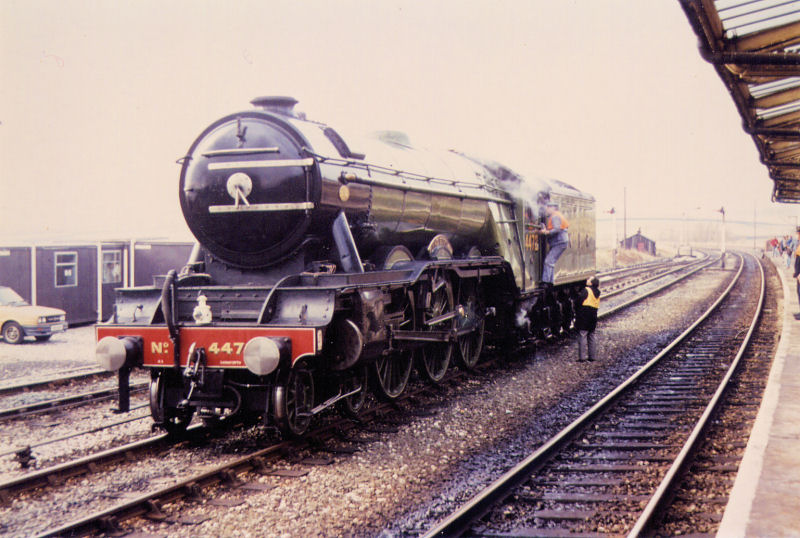 The Cumbrian Mountain Express ran from Carnforth (I think) to Hellifield in the Yorkshire Dales. I assume they rotated through the engines stored at Steamtown as almost every time we went to Hellifield we saw a different steam engine pulling the train. On the 25th of February 1984 the Cumbrian Mountain Express was being pulled by the Flying Scotsman. This time my Dad had a bit more room for taking a photo and so you finally get to see what the Flying Scotsman looks like in real life rather than relying on the Hornby model. Having seen the Flying Scotsman twice in close succession it would be a further 20 years before I would see it again.
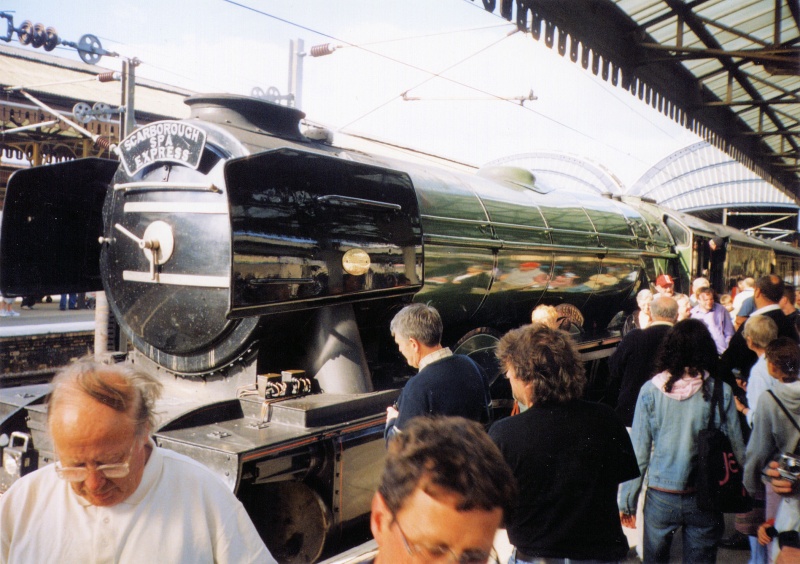 During the summer of 2004, Flying Scotsman ran regularly from York to Scarborough pulling the Scarborough Spa Express train. The last run of the summer was scheduled for the 31st of August and given how close that is to my birthday I was treated to tickets so that I could finally experience being on a train pulled by the Flying Scotsman. We had bought the more expensive tickets so we ate lunch on the train, had a nice walk around Scarborough and then the return trip to York. It was all over far too quickly but I wouldn't have changed any of it.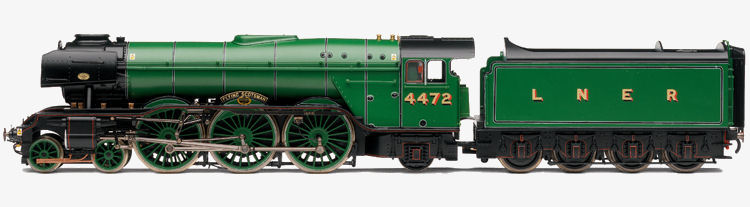
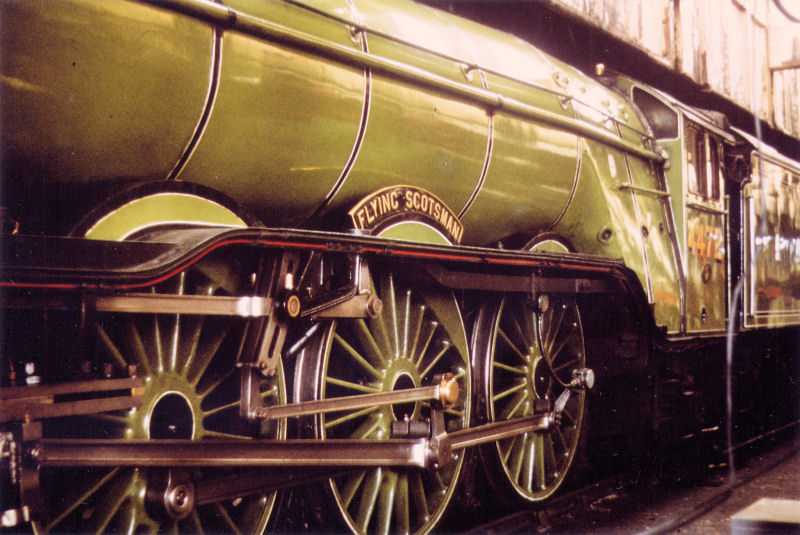 For me the highlight of the day was going to be seeing Flying Scotsman for the first time. It was amazing, and huge. Steam trains still seem large but to a four year old it really was unbelievably big. Unfortunately, it wasn't steaming on the day we visited but it was on display in one of the sheds. Of course given the limited room in the sheds this meant getting photos of it was difficult, but my Dad did his best, and at least managed a photo of the name plate.
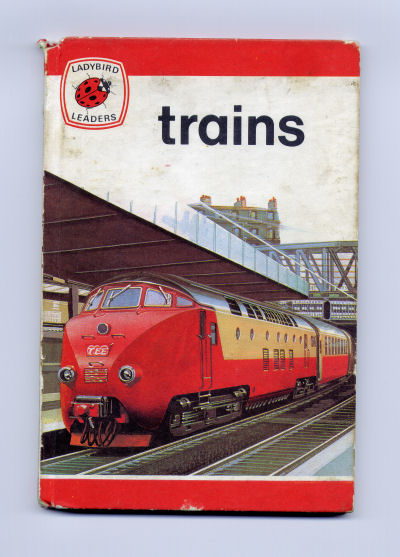 My parents had managed to get me back towards the entrance and attract the attention of a member of staff. For some reason rather than phoning for an ambulance I was driven to the nearby hospital. I think we went in the car of a member of staff who knew the way to the hospital. My mum, brother and grandmother certainly went straight back to where we were staying while my Dad went with me to hospital. To keep me occupied in the car I was given the Ladybird Leaders book of trains from the shop. I don't know how much of it I read or looked at in the car as I was worried about dripping blood onto it. As you can see from the picture even 24 years later it is still in relatively good condition. Ignoring christening presents and the train set this is probably the earliest gift that I still have and cherish in a weird way.
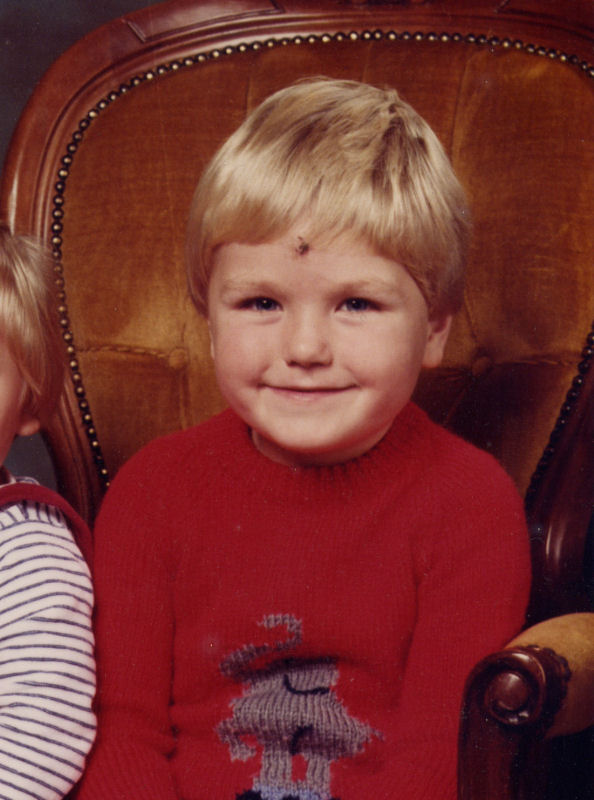 Fortunately I wasn't left with any permanent damage other than a lovely X shaped scare in the middle of my forehead. It is no longer very visible unless I tan, but as you can see from this school photo it used to be a lot more visible.


